"Can I build a guest house in my backyard?" is one of the questions I hear most from Nashville homeowners right now, and for good reason. In December 2025, Metro Council rewrote Nashville's rules for detached accessory dwelling units, or DADUs. Many lots that couldn't have a backyard cottage, garage apartment or in-law suite before now can.
Quick answer
Yes, if your lot qualifies. Since December 2025, Nashville allows one DADU on most residential lots in the Urban Services District without a special overlay. Living space is capped at 700 square feet, or 850 on lots of 10,000 square feet or more. The owner has to live in the main house or the DADU, a licensed contractor has to pull the permit, and new DADUs on single-family (RS) lots can't be short-term rentals.

The catch is that the rules are spread across zoning tables, council amendments and Metro Codes pages, and a lot of what you'll find online is out of date or written for another city. I'm Grant Beauchamp, a REALTOR® with The Wilson Group. This guide pulls the current Nashville DADU rules into one place, in plain English, with the exact steps to check whether your own lot qualifies.
What is a DADU (ADU) in Nashville?
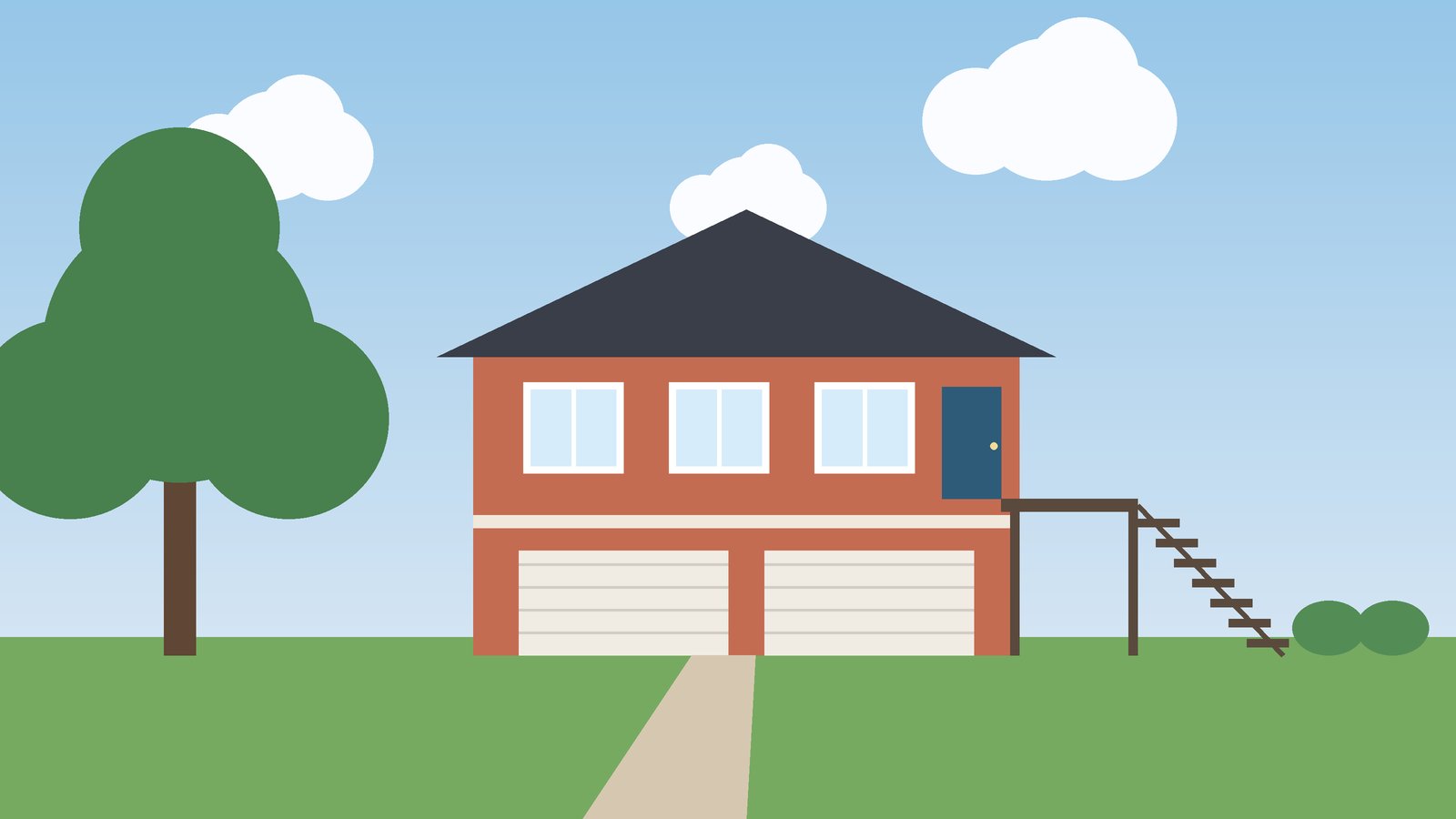
A DADU is Metro Nashville's term for a detached accessory dwelling unit: a small, separate home on the same lot as a single-family house. Other cities call it an ADU, a backyard cottage, a granny flat, a carriage house or an in-law suite. In Nashville, a DADU can be:
- A freestanding backyard cottage
- An apartment above a detached garage
- A unit attached to a workshop or other accessory building
- An existing garage or outbuilding converted into living space
- A tiny home, if it's built and permitted as a permanent DADU that meets these rules
It has to be "clearly subordinate" to the main house in size, height and purpose. It is not a duplex: a DADU can't be sold separately from the house, and Metro treats the two very differently.
What changed: Nashville's new DADU law (BL2025-1007)
Before the change, a Nashville lot usually needed a special DADU overlay, an alley, a historic or design overlay, or more than 15,000 square feet of land to qualify. That ruled out a lot of homeowners.
Metro Council adopted BL2025-1007 on December 4, 2025, on a 29 to 8 vote. The headline changes:
- No overlay needed in the Urban Services District. DADUs became a "permitted with conditions" use in qualifying residential zoning districts across the USD.
- The overlay now mainly serves the General Services District. Outside the USD, a DADU still generally needs a DADU overlay, or a Specific Plan or Urban Design Overlay that allows one.
- New size limits tied to lot size, plus clearer height rules.
- A parking requirement in many areas.
- A short-term rental ban for new DADUs on single-family lots.
A follow-up ordinance, BL2026-1257, passed in April 2026. It allows DADUs on legally created residential lots that are smaller than their zoning district's minimum lot size. If your lot is small or oddly shaped, that may now work in your favor.
How to check if your Nashville lot qualifies for a DADU
Metro Codes lists the eligibility tests on its DADU permitting page. Here's how to run them on your own address in about ten minutes.
- Find your zoning. Search your address in the Metro Parcel Viewer and open the zoning tab. You'll see a base zoning district like RS7.5, RS10 or R6, plus any overlays.
- Check that your zoning allows DADUs. Metro's land use table has to show DADUs as permitted with conditions (PC) in your district. Most single-family and one- and two-family residential districts do.
- Confirm you're in the Urban Services District. Your property tax bill or Assessor record lists USD or GSD. My Nashville property tax guide explains the difference. In the GSD, you'll generally need a DADU overlay, Specific Plan or Urban Design Overlay instead.
- Count the houses. Only one DADU is allowed per lot, and only when there's one single-family house on it. Lots with two principal homes, like a duplex or two-on-a-lot HPR, don't qualify.
- Check your lot size. It decides whether your cap is 700 or 850 square feet, and whether you meet the district minimum. If you don't, ask whether the 2026 change for legally created smaller lots applies to you.
- Look for overlays and easements. Historic and conservation overlays, Specific Plans, floodplains and recorded easements can all change what's possible. More on those below.
If any of that is unclear, Metro's Zoning Help Desk can confirm your eligibility before you pay anyone to design something.
Nashville DADU size limits, height and setbacks
These are the main limits zoning examiners check on a Nashville DADU permit, from Metro Code 17.16.030 and 17.12.040.
| Rule | What Nashville allows |
|---|---|
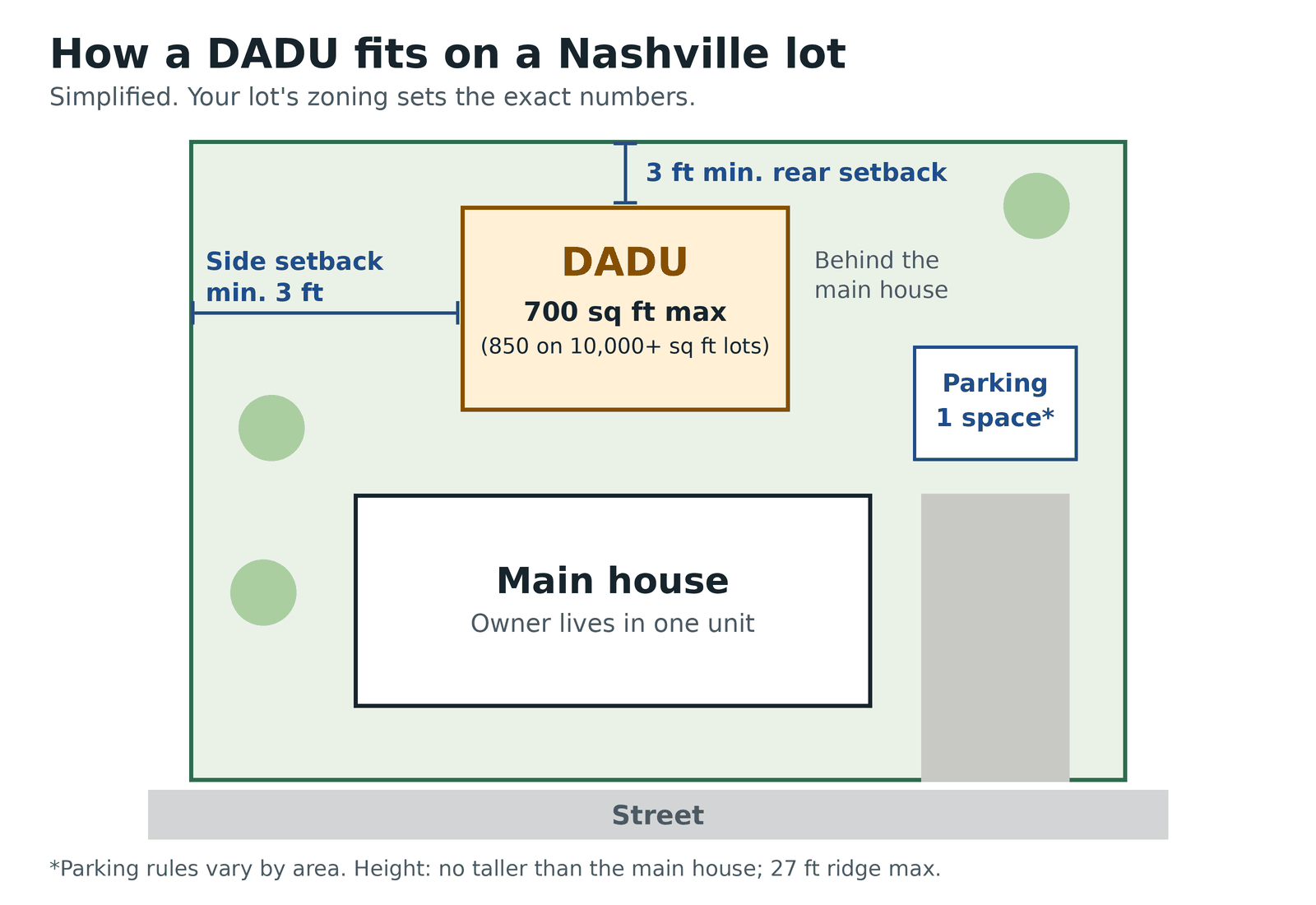
| Living space | Up to 700 sq ft on lots under 10,000 sq ft, or 850 sq ft on lots of 10,000 sq ft or more. It also can't be bigger than the main house. |
| Footprint | Can't exceed the main house's footprint. Once a DADU is on the lot, no other accessory building can be over 200 sq ft. |
| Height | No taller than the main house at the eave line. Max eave height is 10 ft for one story or 17 ft for two stories, and the ridge must be lower than the house and under 27 ft. |
| Rear setback | At least 3 ft for a DADU of 850 sq ft footprint or less behind the house. 10 ft if garage doors open onto an alley. |
| Side setback | Half of what your zoning district requires, but never less than 3 ft. Larger DADUs need the full district setbacks. |
| Design | Similar style, materials, color, roof form and pitch to the main house. Dormers can cover no more than half the roof. |
| Parking | Plan on one off-street space for the DADU in many parts of the county. Rules differ in Nashville's urban zoning overlay, so confirm for your lot. |
Owner occupancy: do you have to live there?
Yes, someone does. Nashville requires that the DADU and the main house be owned by the same person, and that one of the two units be owner-occupied. You can live in the main house and rent the cottage, or move into the cottage and rent the house. What you can't do is rent out both while living elsewhere.
That rule is a big reason Nashville DADUs suit homeowners and house-hackers better than out-of-town investors.
Can a Nashville DADU be an Airbnb?
Usually not, if it's new. Under the 2025 law, on any lot zoned single-family (RS), Residential Neighborhood (RN) or Residential Limited (RL), a newly built DADU, or a garage or outbuilding newly converted into one, can't be used as an owner-occupied short-term rental. New non-owner-occupied short-term rental permits are already limited to certain non-residential zoning districts in Nashville.
In practice, plan on a new DADU being a long-term rental, a home for family, or space for yourself. If short-term rental income is part of your plan, check the exact address before you buy or build. My free Nashville Investor Intel tool can help with short-term rental eligibility, and it's worth confirming with Metro's Short Term Rental office.
Historic overlays, floodplains and other DADU deal-breakers
- Historic and conservation overlays. In a historic preservation or neighborhood conservation overlay, Metro's Historic Zoning Commission enforces setbacks, size and design, and you'll need a historic permit on top of the building permit. Parts of neighborhoods like Sylvan Park sit in conservation overlays.
- Specific Plans and Urban Design Overlays. Metro Planning sets the DADU rules for these.
- Floodplains. Building in a mapped floodplain brings its own rules, including Metro's requirement that new residential structures sit well above the flood elevation. Check your lot's flood zone before you design anything.
- Easements and platted setbacks. A DADU can't be built over an easement or a platted setback, or over a corner lot's side-street setback. Metro Codes doesn't keep easement records, so a survey or title search may be needed.
- Separate cities. Belle Meade and Davidson County's other satellite cities set their own zoning, so Metro's DADU rules may not apply there.
How to get a DADU permit in Nashville, step by step
- Confirm eligibility using the checklist above, or ask Metro's Zoning Help Desk.
- Hire a licensed contractor. Metro doesn't let homeowners pull their own permit to build a DADU or convert a garage into one. A registered contractor has to.
- Prepare plans. You'll need a residential permit application, a site plan with distances to property lines, structures and easements, elevations from all four corners, and a floor plan showing the living space.
- Submit through the Zoning Help Desk or Metro's ePermits system.
- Work the checklist. A zoning examiner reviews the plans and sends a checklist of other approvals, which can include stormwater, water and sewer, and historic review where it applies.
- Pay, build and inspect. Once every sign-off is in, the permit is issued and inspections follow the build. Call Tennessee 811 before anyone digs.
Before you get far, also check your deed restrictions and any HOA rules. Metro's zoning doesn't override a private covenant that bans outbuildings or rentals.
How much does a DADU cost in Nashville, and is it worth it?
Costs vary too much from lot to lot for one honest number, so get bids from contractors who have built DADUs in Davidson County. The biggest swings come from:
- New build vs. conversion. Converting a solid garage is often cheaper than building from scratch, but it still has to meet the same rules.
- Utilities. Running water, sewer and power to the back of the lot, plus any Metro Water connection fees, can be a large line item.
- Site work. Slope, trees, drainage and stormwater requirements.
- Design rules. Matching the main house's materials and roof, and historic review if it applies.
On the value side, a DADU can bring in long-term rental income, house a family member, or give you a home office or guest suite. Because it can't be sold separately, its value shows up in the price of the whole property. If you're weighing a DADU partly as a resale investment, talk with a local agent and an appraiser before you build. I'm happy to run comparable sales with you.
What Nashville's DADU rules mean for you
For homeowners
If you've thought about a place for aging parents, an adult kid, or a little rental income to offset rising costs, it's worth checking your lot now. Many homeowners who were ruled out before 2025 qualify today. And if you're thinking about selling, knowing your lot can take a DADU is a selling point for the right buyer. When you're ready, here's how I help sellers.
For buyers
A house with an existing permitted DADU, or a lot that clearly qualifies for one, can make a Nashville home more affordable through "house hacking": live in one unit and rent the other. Before you count on that income, check that any existing unit was permitted. My guide to checking a Nashville home's permit history shows how. Then talk with your lender about how rental income is treated. See how buying with me works.
For investors
Because one unit has to be owner-occupied, a DADU isn't a play for hands-off investors. It can be a good fit for an investor who plans to live in the property for a while. Remember the short-term rental limits on new DADUs, and run your numbers as a long-term rental. Join my off-market deal list for properties where the math might work.
Nashville DADU FAQ
Can I build a DADU on my property in Nashville?
Probably, if you're in the Urban Services District, your zoning allows DADUs, and there's one single-family house on the lot. Since December 2025 most of those lots don't need a special overlay. Check your zoning in Metro's Parcel Viewer, or ask Metro's Zoning Help Desk to confirm.
How big can a DADU be in Nashville?
The living space can be up to 700 square feet on lots under 10,000 square feet, or 850 square feet on lots of 10,000 square feet or more. It also can't be larger than the main house, and its footprint can't exceed the house's footprint.
Can I rent out a DADU in Nashville?
Yes, as a long-term rental, as long as the owner lives in either the main house or the DADU. New DADUs on single-family (RS), RN and RL lots can't be used as owner-occupied short-term rentals.
Can a DADU be an Airbnb in Nashville?
Not if it's a new DADU, or a newly converted garage or outbuilding, on a lot zoned RS, RN or RL. That restriction took effect with the 2025 ordinance. Check the exact address with Metro's Short Term Rental office before counting on short-term rental income.
Do I need a DADU overlay in Nashville?
Not in most of the Urban Services District since BL2025-1007. In the General Services District, a DADU generally still needs a DADU overlay, a Specific Plan or an Urban Design Overlay that allows one.
Can I convert my garage into a DADU in Nashville?
Often, yes. The converted space has to meet the same DADU rules, a licensed contractor must pull the permit, and on single-family lots it can't become a short-term rental.
Can I sell a DADU separately from my house?
No. A DADU must be owned by the same person as the main house and can't be sold separately. That's the main difference from a duplex.
How tall can a DADU be in Nashville?
No taller than the main house at the eave line, with a maximum eave height of 10 feet for one story or 17 feet for two stories. The roof ridge must be lower than the house's and under 27 feet.
Can I put a tiny home in my backyard in Nashville?
Only if it's built and permitted as a DADU that meets Metro's rules, including size, height, setbacks, owner occupancy and a contractor-pulled permit. For a tiny home on wheels or any other unusual setup, ask Metro's Zoning Help Desk before you buy one.
Send me your address. I'll check if your lot qualifies for a DADU.
I'll look up your zoning, your tax district and any overlays or floodplain on the lot, and tell you what I find and who to call next. Whether you're thinking about building, buying a home with one, or selling a lot that qualifies, it's free and there's no pressure.
This article is general information for educational purposes only. It is not legal, zoning, architectural, engineering, tax or financial advice, and it is not a zoning determination for any property. Zoning rules change, and Metro's interpretation for a specific lot controls. Confirm eligibility, size limits, parking, short-term rental rules and permit requirements for any specific property with Metro Nashville Codes and Building Safety, Metro Planning and, where applicable, the Metro Historic Zoning Commission, and consult a licensed contractor, architect and Tennessee-licensed attorney as needed. Private deed restrictions and HOA rules may also apply. Grant Beauchamp and The Wilson Group make no representations or warranties about whether any property can support a DADU. Illustrations are artistic and not to scale.
Sources: Metro Codes: Build a Detached Accessory Dwelling Unit, BL2025-1007, BL2026-1257, Metro Planning: Housing & Infrastructure legislation FAQs, Metro Codes: Short Term Rentals.
Related: Nashville HPR homes explained. Selling an inherited house in Nashville. Nashville flood zone map: check any address. How to check a Nashville home's permit history. Nashville property tax calculator. Buying new construction in Nashville. See all guides.