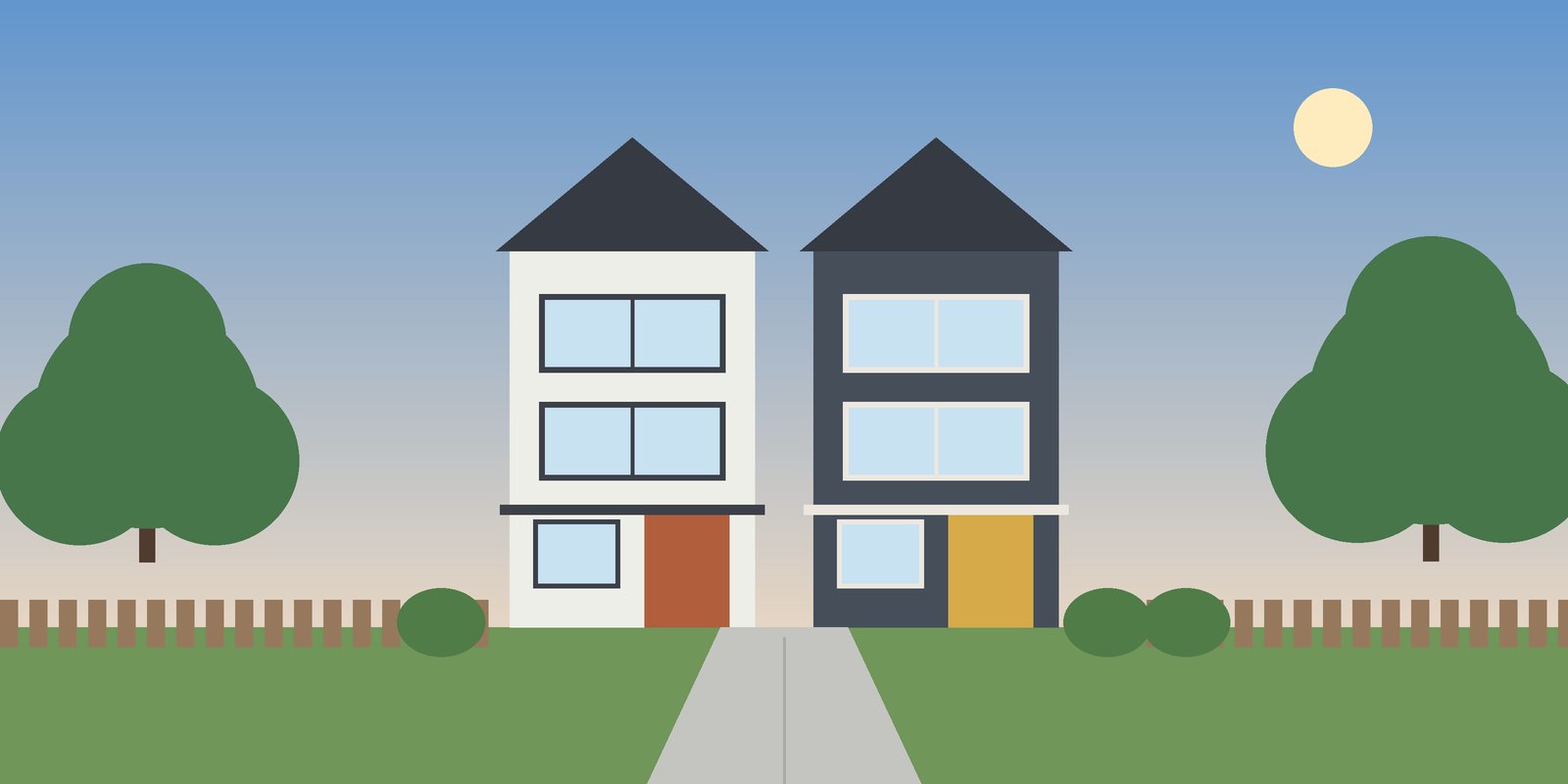
Drive through The Nations, Charlotte Park, Sylvan Park or East Nashville and you'll see them everywhere: two new homes standing side by side where one older house used to be. Many are listed as an "HPR," and plenty of buyers aren't sure what that means until they're already under contract. You can see a few of them in my video tour of The Nations.
Quick answer
An HPR, or Horizontal Property Regime, lets two or more homes on one Nashville lot be owned and sold separately. You own your home and share "common elements," like the land or a driveway, with your neighbor. A recorded master deed and bylaws say who owns, maintains and insures what. Read them before you buy.
I'm Grant Beauchamp, a REALTOR® with The Wilson Group, and HPRs come up constantly with the buyers I work with on Nashville's west side. They can be a great way into a neighborhood you couldn't otherwise afford. This guide explains exactly what you're buying, so you can decide with your eyes open.
What is an HPR (Horizontal Property Regime)?
A Horizontal Property Regime is a form of shared ownership under Tennessee's Horizontal Property Act. The owner of a property records a master deed (or a plat) that divides it into separately owned units, plus common elements that the owners share. Bylaws recorded with it set the rules for running the property.
The same law underlies many condominiums, which is why an HPR home is sometimes described as a "detached condo." Newer regimes may be set up under the Tennessee Condominium Act of 2008 instead. Either way, the recorded documents are the rulebook for your property.
Why Nashville has so many HPR homes
Much of Nashville's older housing sits on lots zoned for one- and two-family homes (R zoning). A builder can often put two homes on one of those lots, but splitting it into two separate lots isn't always possible. An HPR lets the builder sell each home to a different owner without subdividing the land.
That's why infill neighborhoods are full of matching "tall-skinny" pairs. Single-family (RS) lots generally don't allow a second principal home, so you'll find HPRs mostly on R-zoned streets.
What do you actually own in an HPR?
- Your unit. Your home, which you own outright, and in many HPRs the land directly under it.
- A share of the common elements. Things both owners share, often the land itself, a shared driveway, walkways or utility lines. Tennessee law says common elements stay undivided and can't be split up through a lawsuit for partition.
- Limited common elements. Shared property set aside for one unit's use, often each home's yard, patio or parking pad.
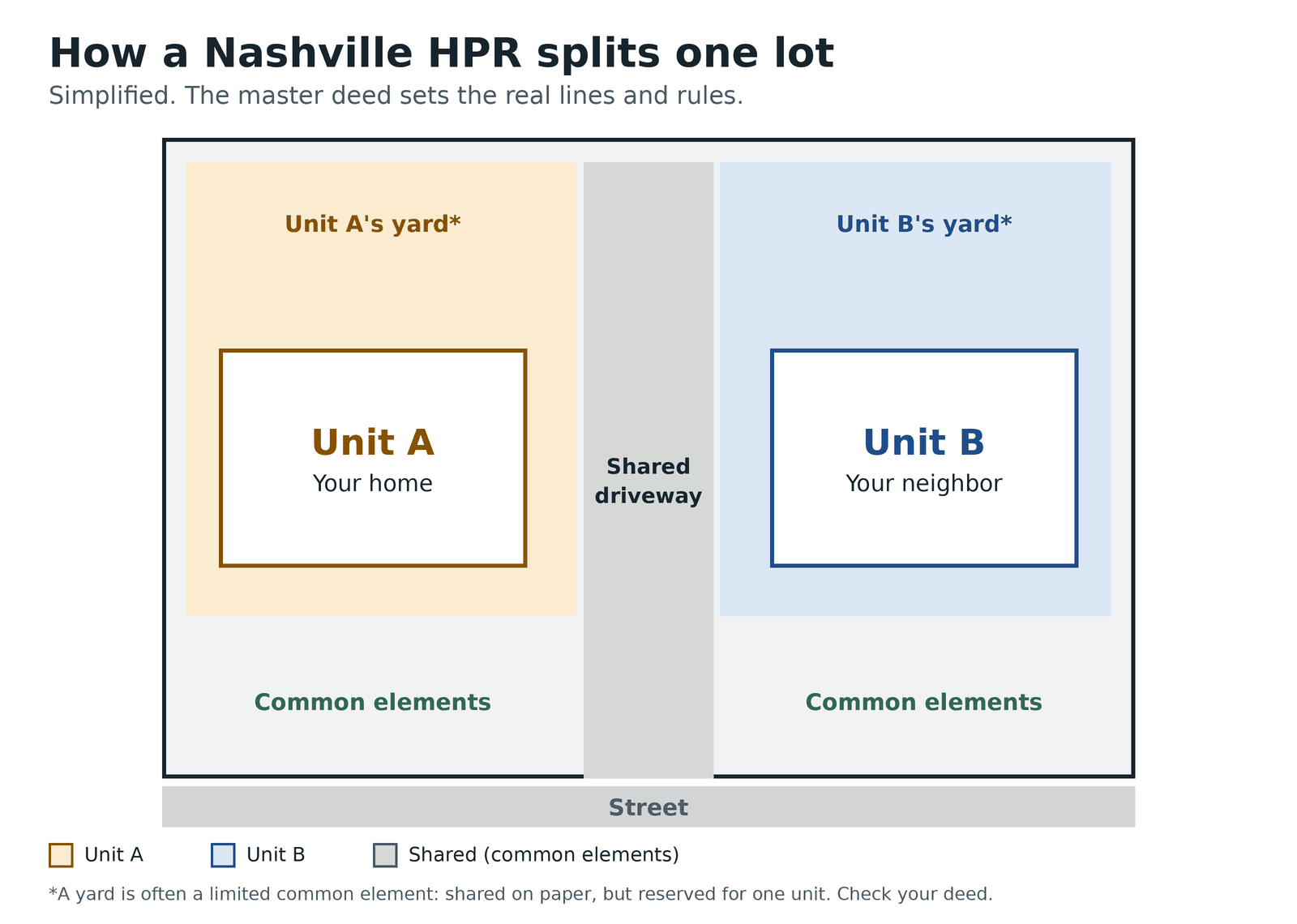
Shared costs are split according to the master deed and bylaws, and Tennessee law gives the regime a lien for unpaid shared expenses. In most two-unit Nashville HPRs there's no formal HOA. The two owners simply coordinate, which works well when neighbors communicate and less well when they don't.
HPR vs. condo vs. duplex vs. townhome in Nashville
| Type | How it usually works |
|---|---|
| HPR | Separately owned homes, often detached, on one lot. Shared common elements governed by a master deed and bylaws. Usually two units in Nashville infill. |
| Condo | Usually units in a larger building or community with a formal association, dues and a master insurance policy. |
| Duplex | One building with two units on one deed. Buying a duplex usually means buying both sides. |
| Townhome | Attached homes, often each on its own small lot within a planned development with an HOA. |
Listings don't always use these terms precisely, so the recorded documents, not the listing description, tell you what you're buying.
How to read an HPR master deed and bylaws
The master deed and bylaws are recorded with the Davidson County Register of Deeds. Get copies early, ideally before your offer or at least within your inspection period, and look for:
- What's yours and what's shared. Is the land under your home part of your unit or a common element? What about the yard and driveway?
- Who maintains what. Roof, exterior siding, the shared driveway, fences, landscaping, sewer and water lines.
- How costs are split. Fifty-fifty, by square footage, or some other share, and how owners collect from each other.
- Insurance requirements. Whether there's a master policy or each owner insures their own building, and the minimum coverage.
- Exterior changes and additions. Whether you need the other owner's written consent to paint, add a deck, fence the yard or expand.
- Rentals and other uses. Any limits on renting your unit or on short-term rentals.
- Disputes and amendments. How owners resolve disagreements and how the documents can be changed.
If anything is unclear, have a Tennessee real estate attorney review the documents. I'm not an attorney, but I can help you spot the questions to ask.
HPR insurance: who covers what?
Tennessee's Horizontal Property Act addresses building insurance, and each master deed sets the specific requirements. In many two-unit Nashville HPRs, each owner insures their own home. Others use a shared policy. Before you close:
- Give your insurance agent the master deed and bylaws, not just the address.
- Ask whether your policy covers your share of common elements, like a shared driveway or retaining wall.
- Ask what happens if a shared element is damaged and the other owner isn't insured.
- Check the flood zone. Plenty of HPRs sit in creek-side neighborhoods.
Can you get a mortgage on an HPR in Nashville?
Yes, but tell your lender it's an HPR before you apply. Because of the shared ownership, lenders may review the property more like a condo or planned development than a standard single-family home. Requirements vary by loan type and lender:
- Conventional loans may involve a project review or questionnaire.
- FHA loans on condo-style properties generally need FHA project approval or a single-unit approval.
- VA loans can have their own project requirements.
Lenders who regularly close Nashville HPRs know how to handle them. Ask early, so financing doesn't stall under contract. See how buying with me works.
HPR buyer checklist
- Get the recorded master deed and bylaws, and read the sections above.
- Ask whether there's any shared account, reserve or outstanding shared bill.
- Find out who owns and lives in the other unit, an owner-occupant or a renter.
- Check permits on both units. My guide to checking a Nashville home's permit history shows how.
- Inspect the shared elements too: driveway, drainage, retaining walls and utility lines.
- Look at the stairs. Most HPRs are tall and narrow, which matters if you want one-level living.
- Budget your property taxes. Each HPR unit usually has its own tax bill. My property tax calculator helps estimate it.
- Buying a new one? Read my new construction guide first. Many HPRs are new builds.
Pros and cons of buying an HPR
Pros
- A newer, often larger home in an established neighborhood, usually for less than a single-family home on its own lot.
- Your own front door, no shared walls in a detached HPR, and often no HOA dues.
- Walkable, close-in locations like The Nations, Charlotte Park and Sylvan Park.
Cons
- Shared decisions. Exterior changes, repairs to shared elements and some uses may need the other owner's agreement.
- Smaller yards, and often lots of stairs.
- No room to grow. A lot with two principal homes can't add a backyard cottage under Nashville's DADU rules.
- Financing and insurance take a little more homework.
If you're selling an HPR, having your recorded documents, insurance details and a record of shared repairs ready makes buyers far more comfortable. Here's how I help sellers.
Nashville HPR FAQ
What does HPR mean in Nashville real estate?
HPR stands for Horizontal Property Regime. It's a legal structure under Tennessee law that lets two or more homes on one lot be owned separately, with shared ownership of common elements like the land or a driveway.
Do I own the land with an HPR?
It depends on the master deed. In many HPRs, the land is a common element shared by both owners, with each yard set aside for one unit. In others, the land under each home is part of the unit. Read the recorded master deed.
Is an HPR the same as a condo?
They're closely related, since both come from Tennessee's horizontal property and condominium laws. The difference is scale. A typical Nashville HPR is two detached homes on one lot, often without a formal HOA. Most condos are in larger buildings with an association.
Do HPRs have HOA fees?
Many two-unit Nashville HPRs have no formal HOA or dues. The owners split shared costs as the master deed and bylaws require. Larger HPR communities may have an association with dues.
Can you get an FHA loan on an HPR?
Sometimes. Lenders may treat an HPR like a condo, and FHA generally requires project approval or a single-unit approval for condo-style properties. Ask an FHA lender who regularly closes Nashville HPRs.
Do HPR units have separate property tax bills?
Usually, yes. Each unit typically has its own parcel and tax bill in Davidson County. Confirm with the Assessor's record for the specific unit.
Can I add on to or change the outside of my HPR home?
Often only with the other owner's written consent, depending on the master deed and bylaws. Building permits and zoning rules also apply.
Can I build a DADU on an HPR lot in Nashville?
No. Metro Nashville only allows a detached accessory dwelling unit on a lot with one single-family home, so lots with two principal homes don't qualify.
Looking at an HPR? Send it to me before you offer.
Send the listing or address. I'll pull the recorded master deed and bylaws, flag what to look at, and tell you what similar HPRs nearby have sold for. Free, and no pressure.
This article is general information for educational purposes only. It is not legal, insurance, lending or tax advice. HPR ownership, maintenance, insurance and use depend on the recorded master deed, bylaws and plat for each property, which control over anything here. Have a Tennessee-licensed real estate attorney review the documents, and confirm insurance and financing with licensed professionals. Grant Beauchamp and The Wilson Group make no representations or warranties about any HPR property or its documents. Illustrations are artistic and not to scale.
Sources: Tenn. Code § 66-27-103 (establishing an HPR), Tenn. Code § 66-27-107 (master deed contents), Tenn. Code § 66-27-106 (owner rights), Metro Codes: DADU eligibility, Metro Planning: zoning legislation FAQs.
Related: Buying new construction in Nashville. Nashville DADU rules. Nashville flood zone map. Selling an inherited house in Nashville. See all guides.