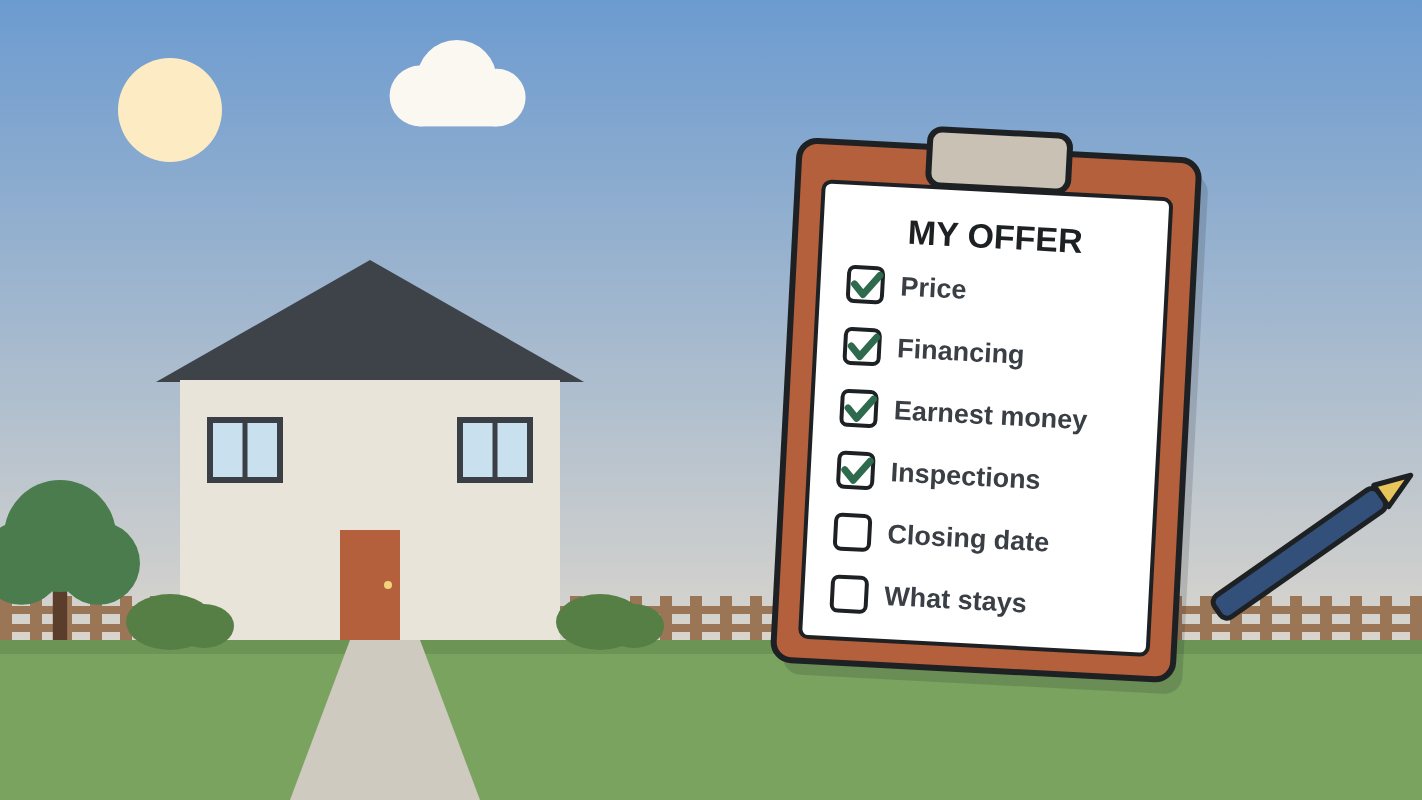
Found the house? The next step is writing an offer, and in Tennessee that means filling out a legally binding purchase contract with a lot of decisions in it. Price is only one of them. Earnest money, inspection deadlines, the appraisal, your closing date and even who keeps the refrigerator all go into the same document.
Here's what goes into a Nashville offer, what's normal right now, and how my free offer questionnaire helps you make every decision before we write it up.
The short answer
To make an offer on a house in Nashville, you'll decide:
- Price, based on recent nearby sales, not just the list price
- How you're paying: loan type, down payment, pre-approval or proof of funds
- Earnest money: how much, who holds it, and when it's due
- Appraisal: what happens if the home appraises low
- Inspections: how many days, and which inspections
- Closing date and possession: when you close and move in
- What stays: appliances, fixtures and anything else
- Disclosures, HOA and warranty
- Other terms: selling another home first, special requests, and how long the seller has to respond
Your agent puts those decisions into the Tennessee REALTORS Purchase and Sale Agreement, you sign it electronically, and it goes to the seller's agent.
My offer questionnaire: every decision in one place
When a client is ready to write an offer, the slowest part is usually a back-and-forth of texts: "How much earnest money? Who's your lender? Do you want the washer and dryer?" So I built an offer questionnaire that walks you through every decision in one place:
- Short sections, from your legal names and how you'll take title, to inspections, closing and special requests
- Plain-English help on each question, like what an appraisal gap means or why homes built before 1978 come with a lead paint disclosure
- "Not sure" is always OK. Leave your best guess and we'll talk it through.
- Review before you send, then I turn your answers into the contract for you to review and sign
The questionnaire isn't an offer or a contract. It just makes sure nothing gets missed. If we're not working together yet, we'll sign a written buyer agreement first, which current rules require before I can write your offer.
What goes in a Tennessee offer, section by section
Price and financing
Base your price on recently sold homes nearby, adjusted for condition and features, not on the list price or a website estimate. With a loan, include your pre-approval letter; with cash, include a recent bank or brokerage statement as proof of funds. Most financed offers include a financing contingency, which protects you if your loan isn't approved on the contract's terms.
Earnest money
Earnest money shows the seller you're serious. In Nashville it's commonly around 1% to 2% of the price, held by the listing brokerage or the title company, and credited toward your costs at closing. The contract sets how many days you have to deliver it. Always confirm wiring instructions by phone with the title company at a number you look up yourself.
Appraisal
If you're financing, the lender orders an appraisal. If it comes in below your price, you can renegotiate, cover the difference in cash, or walk away, depending on your contract. In a competitive situation, some buyers offer to cover an appraisal gap up to a set amount.
Inspections and due diligence
Most buyers ask for an inspection period (often about 7 to 10 days) followed by a resolution period to negotiate repairs. You can add a termite (WDI) letter, a survey, a radon test, a sewer scope and other checks. For homes built before 1978, federal rules give you an opportunity to test for lead-based paint. It's also a good time to check the flood zone and permit history.
Closing and possession
Financed purchases typically close in about 30 days; cash can close faster. Possession usually happens at closing. If the seller needs a few extra days, that's handled with a separate occupancy agreement. You also choose the closing agency, usually a title company.
What stays with the home
Anything attached to the house usually stays, but appliances, TV mounts, curtains and outdoor items cause confusion. List them. Ask about leased items like solar panels, a propane tank or an alarm contract, too.
Disclosures, HOA and warranty
Tennessee sellers generally provide a property disclosure statement, a disclaimer statement (selling as-is), or claim an exemption. Read it before you offer. If there's an HOA, make the offer subject to your review of the HOA documents, and decide who pays transfer fees. You can also ask the seller to pay for a home warranty.
Other terms
Need to sell your current home first? That's a home sale contingency, and it can weaken an offer in a hot market. Special stipulations cover anything else, from a specific repair to a closing date that matches your lease. Finally, set an offer deadline, so the seller has to respond by a certain time.
From accepted offer to closing
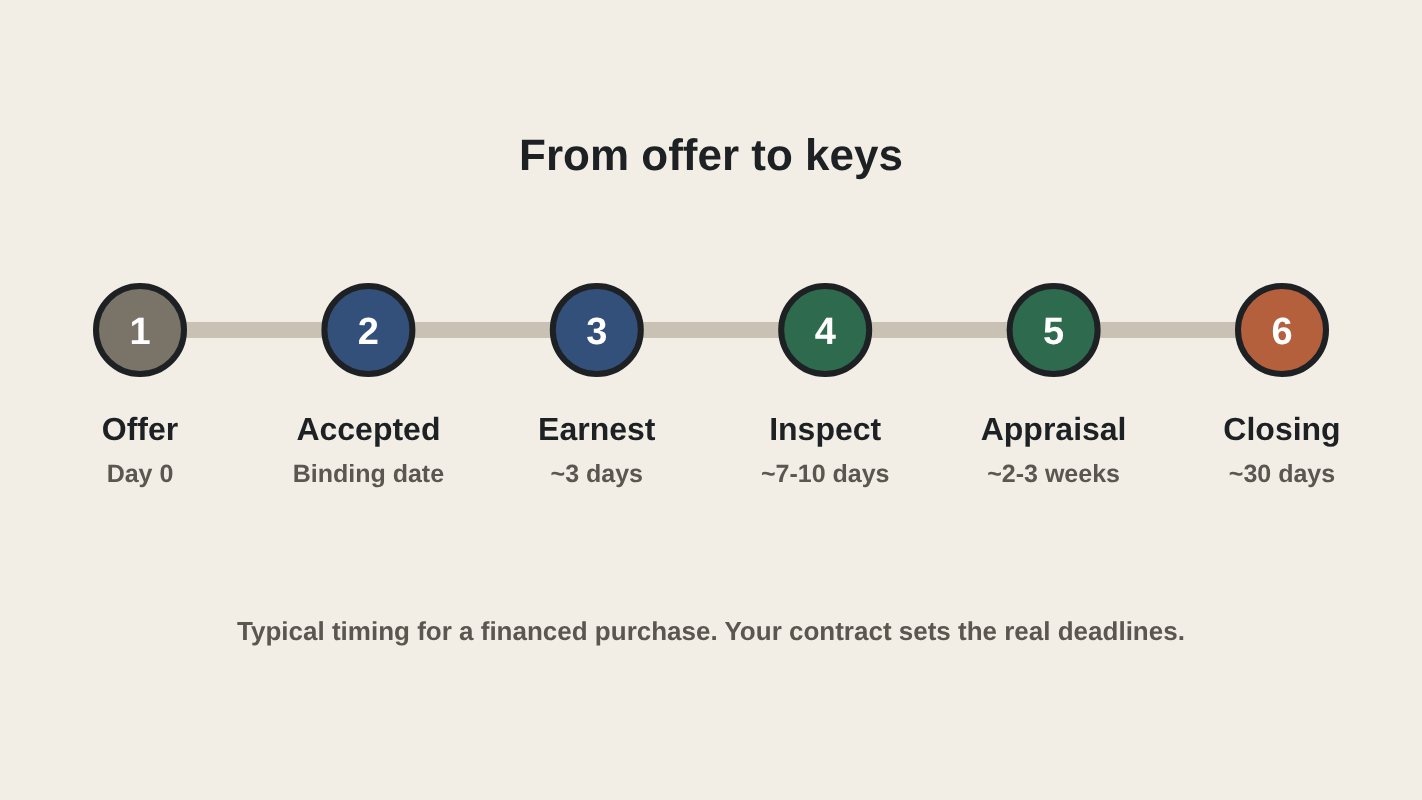
Once both sides sign and acceptance is communicated, you have a Binding Agreement Date, and most deadlines count from it. Put every deadline on your calendar. Then plan for closing costs and your cash to close.
How to make your offer stronger in Nashville
- Get fully pre-approved, not just pre-qualified, and have your lender ready to take a call from the listing agent.
- Be flexible on closing and possession. Ask the listing agent what timing helps the seller.
- Tighten deadlines you can actually meet, like a shorter inspection period with inspectors already lined up.
- Consider an escalation clause or appraisal gap coverage in multiple-offer situations, with caps you're comfortable with.
- Ask for help where it counts. When homes have been sitting, seller credits toward closing costs or a rate buydown can be worth more to you than a lower price.
- Skip the personal letter. Letters to sellers can raise fair housing concerns, and many listing agents won't forward them.
Common offer mistakes to avoid
- Offering without reading the seller's disclosure or HOA rules
- Waiving inspections or the appraisal without understanding the risk
- Missing a contract deadline, which can put your earnest money at risk
- Wiring money based on emailed instructions alone
- Forgetting about property taxes and insurance when you set your budget
First-time buyer? See which Tennessee homebuyer programs may fit you and how down payment assistance in Nashville works. More on my buyer services.
Frequently asked questions
How do I make an offer on a house in Nashville?
Your agent writes the offer on the Tennessee REALTORS Purchase and Sale Agreement, using your decisions on price, financing, earnest money, inspections, appraisal, closing date and what stays with the home. You sign it electronically, and your agent sends it to the seller's agent with your pre-approval letter or proof of funds. My free offer questionnaire walks you through every decision in one sitting.
How much earnest money is normal in Nashville?
There's no set amount. Many Nashville offers include roughly 1% to 2% of the price, and more in competitive situations. Earnest money is usually held by the listing brokerage or the title company and is credited toward your costs at closing.
How long is the inspection period in Tennessee?
It's whatever the contract says. Many Nashville buyers ask for about 7 to 10 days to inspect, then a few days to negotiate repairs. A shorter period can make your offer more attractive, but make sure you can schedule inspectors in time.
What is the Binding Agreement Date in Tennessee?
It's the date the final acceptance of the offer is communicated to the other side. Most contract deadlines, such as earnest money, inspections and financing, are counted from that date, so write it down.
Can I back out after my offer is accepted in Tennessee?
Usually only as the contract allows, for example during your inspection period or if your loan isn't approved under a financing contingency. Miss a deadline or back out for a reason the contract doesn't cover and you may lose your earnest money. Talk to your agent and, if needed, a Tennessee real estate attorney before you act.
What is an escalation clause?
An escalation clause automatically raises your price above a competing offer by a set amount, up to a maximum you choose. It can help in multiple-offer situations, but some sellers don't accept them, and your cap should be a price you're truly comfortable paying.
Should I write a letter to the seller?
I generally recommend against it. Personal letters can reveal details that raise fair housing concerns, and many listing agents won't pass them along. A clean, well-supported offer usually does more.
Found a home you love?
Send me the address. I'll pull recent sales so you know what to offer and walk you through the rest, with no pressure and no cost to ask.
Disclaimer. This article is general information for educational purposes only. It is not financial, lending, tax, legal, insurance or investment advice, and it doesn't create an agency relationship. All figures are estimates based on the third-party sources and dates listed below; prices, rents, interest rates, tax rates, insurance premiums and utility rates change frequently and vary by property and household. Typical timelines and amounts are examples, not rules; your signed contract controls. A Tennessee purchase agreement is legally binding: read every document, and consult a Tennessee real estate attorney with legal questions. The offer questionnaire collects information to help prepare an offer and is not itself an offer or contract. Grant Beauchamp is a real estate licensee, not a mortgage lender, CPA, attorney or financial advisor; talk to a licensed lender, tax professional or attorney before making decisions. Grant Beauchamp and The Wilson Group Real Estate make no representations or warranties about the accuracy or completeness of this information and aren't responsible for decisions made based on it. See the site's terms of use. Equal Housing Opportunity.
Sources: Tennessee REALTORS forms, EPA: lead-based paint disclosure rule, Tenn. Code Ann. § 66-5-201 et seq.: residential property disclosures, CFPB: buying a house.
Related: Nashville closing costs. Tennessee homebuyer programs checker. Cost of living in Nashville. How much you need to make to buy in Nashville. Nashville property tax calculator. Nashville neighborhood guides. All guides.