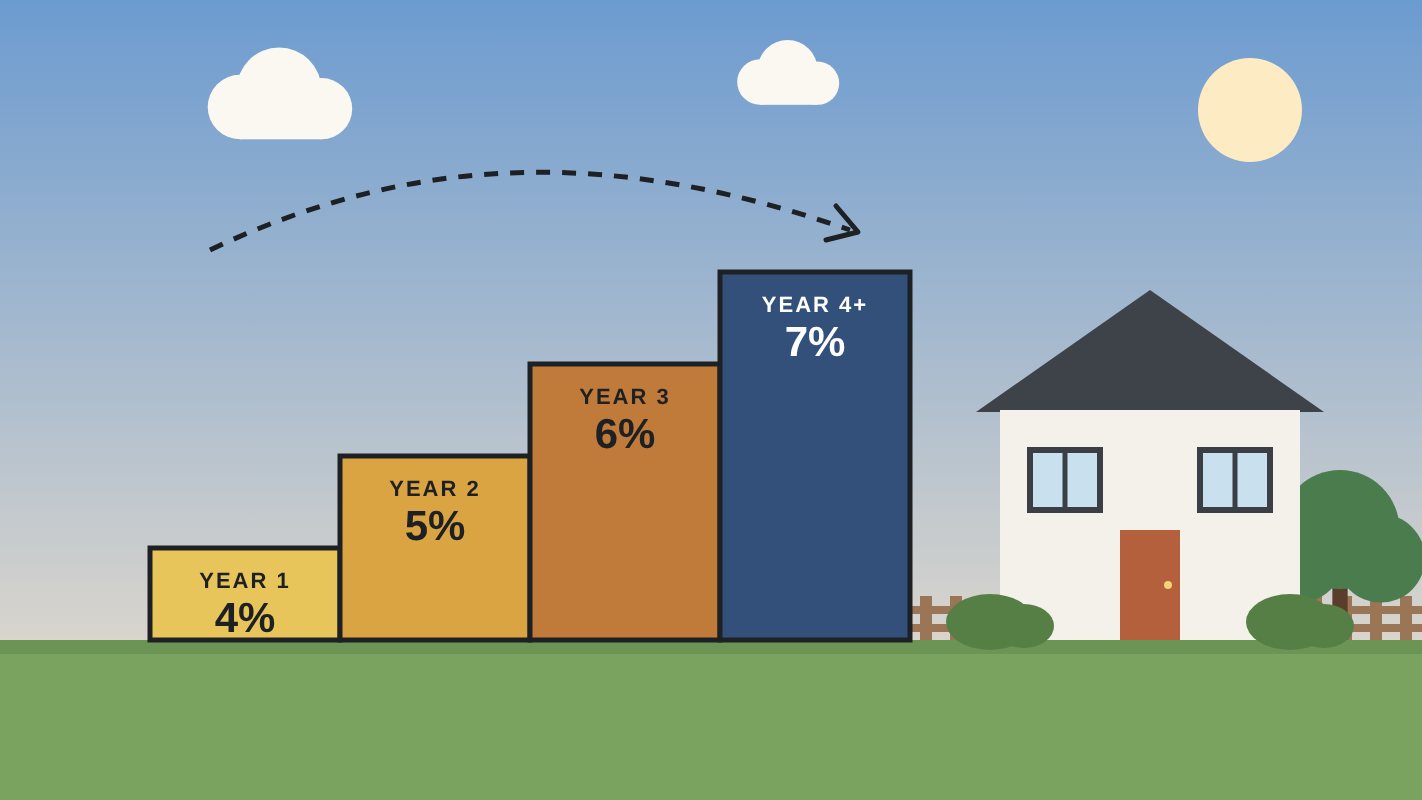
When a house sits, the usual move is a price cut. But with mortgage rates around 7%, many buyers care more about the monthly payment than the price. That's where a seller-paid rate buydown comes in. Dollar for dollar, a buydown can cut a buyer's payment far more than the same money taken off the price, at least for the first few years.
Here's how 2-1 and 3-2-1 buydowns work, how they compare with a price reduction in real monthly payments, and a calculator to run your own numbers.
The short answer
- Price cut of $9,440
- $57/molower payment, for the life of the loan
- 2-1 buydown, same $9,440
- $520/molower in year 1, $266 lower in year 2
- 3-2-1 buydown
- $761/molower in year 1; costs about $18,571
- Rule of thumb
- $60/moper $10,000 off the price at 7%, 10% down
Example: $450,000 home, 10% down ($405,000 loan), 30-year fixed at 7%, principal and interest only. Freddie Mac's 30-year average was 7.11% on November 12, 2026.
What is a temporary rate buydown?
A temporary buydown lowers your mortgage rate for the first one to three years. Someone, usually the seller or a builder, pays the difference up front. That money goes into an escrow account at closing, and each month the lender pulls from it to cover the gap between your lower payment and the full payment.
- 1-0 buydown: 1 point lower for year 1.
- 2-1 buydown: 2 points lower in year 1, 1 point lower in year 2.
- 3-2-1 buydown: 3, 2 and 1 points lower in years 1, 2 and 3.
After that, you pay the full note rate for the rest of the loan. Your loan amount and note rate never change; only the payments in the early years do.
2-1 vs. 3-2-1 buydown, in monthly payments
| 2-1 buydown | 3-2-1 buydown | |
|---|---|---|
| Year 1 | $2,174 (5%) | $1,934 (4%) |
| Year 2 | $2,428 (6%) | $2,174 (5%) |
| Year 3 | $2,694 (7%) | $2,428 (6%) |
| Year 4 on | $2,694 (7%) | $2,694 (7%) |
| Total savings | $9,440 | $18,571 |
The cost of a buydown is simply the total of the payment savings, so a 3-2-1 costs about twice as much as a 2-1. A 2-1 is the more common choice: it's cheaper for the seller, fits within more concession limits, and still gives the buyer a big break in year one.
Buydown vs. price reduction: the monthly payment math
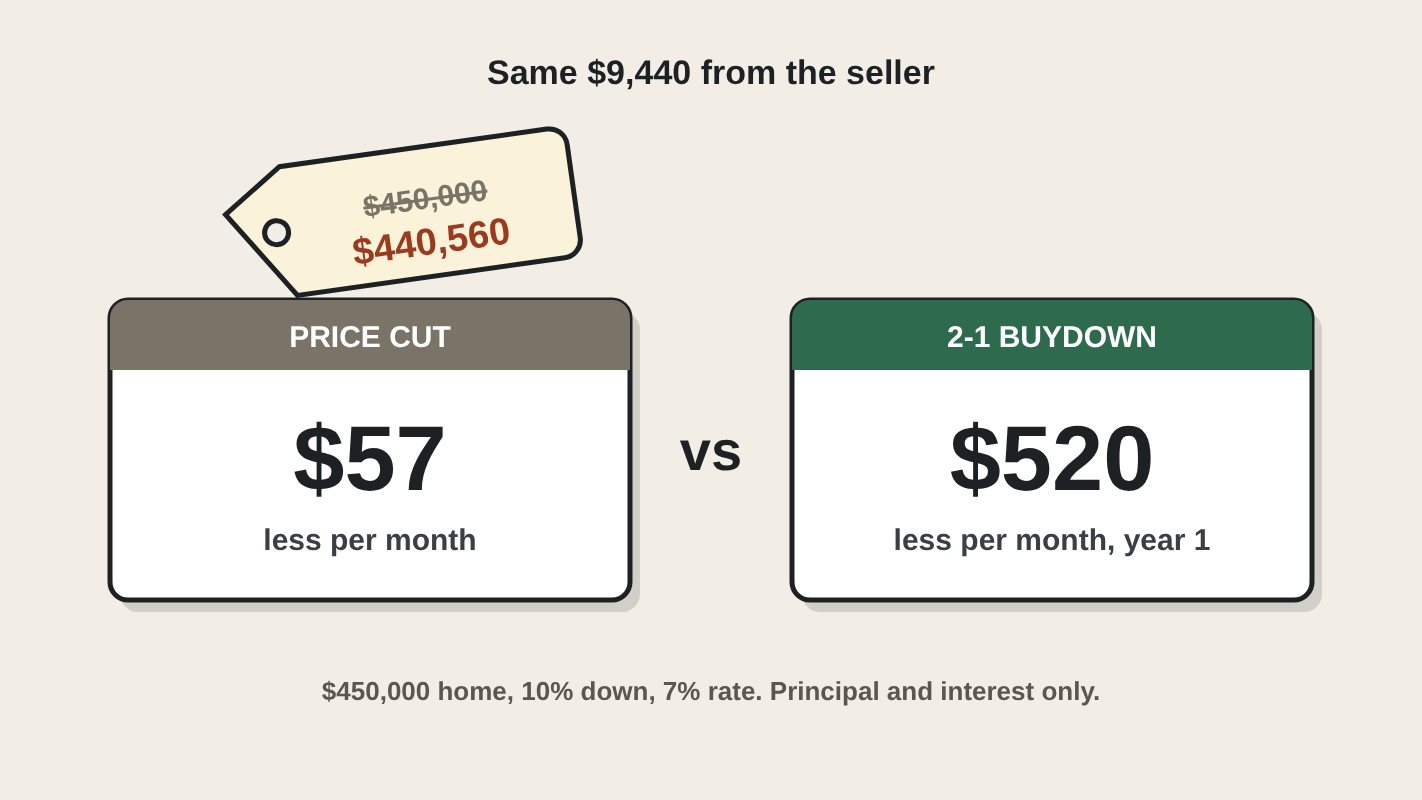
Here's why a price cut moves the payment so little: with 10% down, only 90% of a price cut comes off your loan, and that savings is spread over 360 payments. At 7%, every $10,000 off the price lowers the payment by only about $60 a month.
A buydown puts all of the seller's money toward your first 24 or 36 payments instead. So the same $9,440 that saves $57 a month as a price cut saves $520 a month in year one as a 2-1 buydown, about nine times as much.
| $9,440 goes to… | Year 1 payment | Year 2 | Year 3 on |
|---|---|---|---|
| Nothing | $2,694 | $2,694 | $2,694 |
| Price cut | $2,638 | $2,638 | $2,638 |
| 2-1 buydown | $2,174 | $2,428 | $2,694 |
| Permanent points* | $2,538 | $2,538 | $2,538 |
*Assumes each discount point (1% of the loan) lowers the rate about 0.25%, a common rule of thumb; actual pricing varies by lender and day. Principal and interest only. A price cut also trims property tax slightly, about $6 a month here in Nashville's Urban Services District.
The trade-off: the buydown's savings end after year two, while a price cut and permanent points keep saving for the life of the loan. Who comes out ahead depends on how long you keep the loan.
2-1 and 3-2-1 buydown calculator
Compare a buydown with a price cut
Enter the home and loan, plus how much the seller could put toward the deal. Example numbers are filled in; replace them with yours.
Monthly principal and interest only; taxes, insurance, HOA and mortgage insurance are extra. Price cut and points use the "seller money" amount. Points assume about 0.25% lower rate per point; actual pricing varies by lender. Concession limits shown are typical: conventional 3% (under 10% down), 6% (10% to 25% down) or 9% (25% or more), FHA 6%, VA 4%. An estimate for comparison only, not a loan offer.
Why sellers often prefer a buydown
- It protects your sale price. The contract price stays the same, and the buydown shows up as a seller concession. That keeps the recorded sale price, and the comps your neighbors will be priced from, higher.
- It reaches more buyers. Many buyers shop by monthly payment. Advertising "2-1 buydown available, payments from $X" can bring in buyers who'd otherwise scroll past.
- Same cost to you. A $9,440 buydown and a $9,440 price cut leave you with roughly the same net, but the buyer gets far more help in the early years.
- It's common with Nashville builders. New construction communities around Nashville often offer rate buydowns as an incentive. See my guide to buying new construction in Nashville.
When a price cut is the better deal
- You'll keep the loan a long time and rates stay put. A price cut keeps saving every month for 30 years, and permanent points do too. Over the full loan, the price cut's total savings can come out ahead.
- You need less cash to close. A lower price means a smaller down payment and slightly lower transfer tax. A buydown doesn't change either.
- Appraisal is a concern. If the home may appraise low, a lower contract price can help the deal hold together.
- You can't comfortably afford the full payment. You qualify at the note rate for a reason. Don't count on refinancing before the buydown ends; rates might not drop.
- You're near a concession limit. A buydown counts toward the limits on what a seller can contribute, along with any closing cost help.
Many buyers like a buydown because if rates fall, they can refinance, and under Fannie Mae's rules unused buydown funds are typically credited toward the payoff. Just make sure the full payment works for you on its own.
Buydown rules and limits to know
- You qualify at the note rate, not the bought-down rate.
- Conventional loans: Fannie Mae allows temporary buydowns on fixed-rate loans for primary residences and second homes, with a maximum 3-point reduction, no more than a 1-point increase per year and up to 3 years. Investment properties aren't eligible.
- Seller concession limits: the seller's buydown counts toward caps that typically run 3% to 9% of the price on conventional loans (depending on your down payment), 6% on FHA loans and 4% on VA loans.
- Put it in the contract. The buydown is written into your offer as a seller concession and set up through your lender, so talk to your lender before you write the offer.
- Not every lender offers every type. Some don't offer 3-2-1 buydowns, or only on certain loans.
More for buyers: Nashville closing costs, how much you need to make to buy in Nashville and my buyer services. Selling? See how I help sellers.
Frequently asked questions
What is a 2-1 buydown?
A 2-1 buydown is a temporary rate reduction paid for up front, usually by the seller or builder. Your rate is 2 percentage points below your loan's note rate for the first year and 1 point below for the second year, then it stays at the full note rate for the rest of the loan. On a $405,000 loan at 7%, that's about $520 less per month in year one and $266 less in year two.
What is a 3-2-1 buydown?
A 3-2-1 buydown lowers your rate by 3 points in year one, 2 points in year two and 1 point in year three, then it returns to the note rate from year four on. It saves more up front than a 2-1 buydown but costs roughly twice as much to fund.
Is a 2-1 buydown better than a price reduction?
Often, if your goal is a lower payment. On a $450,000 home with 10% down at 7%, a $9,440 2-1 buydown lowers the payment by about $520 a month in year one, while a $9,440 price cut lowers it by about $57 a month. A price cut wins if you plan to keep the loan a long time and rates don't fall, because its savings last for the life of the loan.
How much does a 2-1 buydown cost?
The cost equals the total payment savings over the buydown period. On a $405,000 loan at 7%, a 2-1 buydown costs about $9,440 and a 3-2-1 about $18,571. That's roughly 2.3% and 4.6% of the loan amount. Your lender calculates the exact figure.
Do I qualify at the lower buydown rate?
No. Lenders qualify you at the full note rate, so you need to be able to afford the payment after the buydown ends. The buydown makes the first years easier, but it doesn't help you qualify for a bigger loan.
What happens to buydown money if I refinance or sell?
Under Fannie Mae's rules, unused buydown funds are typically credited toward your loan payoff if you refinance or sell before the buydown period ends, or handled as your buydown agreement says. Ask your lender how its agreement treats unused funds before you close.
Can investors use a 2-1 buydown?
Generally not on conventional loans. Fannie Mae allows temporary buydowns on fixed-rate loans for primary residences and second homes, not investment properties. FHA and VA loans can also allow seller-paid temporary buydowns, subject to their own rules and concession limits.
Want to run buydown numbers on a real house?
Tell me whether you're buying or selling and the price range. I'll put together a buydown vs. price cut comparison for you, with no pressure and no cost to ask.
Disclaimer. This article is general information for educational purposes only. It is not financial, lending, tax, legal, insurance or investment advice, and it doesn't create an agency relationship. All figures are estimates based on the third-party sources and dates listed below; prices, rents, interest rates, tax rates, insurance premiums and utility rates change frequently and vary by property and household. Calculator results are illustrations only, not a loan offer, rate quote, pre-approval or guarantee of what you'll qualify for. Buydown availability, cost, eligibility and concession limits are set by your lender and loan program. Talk to a licensed mortgage lender before you decide. Grant Beauchamp is a real estate licensee, not a mortgage lender, CPA, attorney or financial advisor; talk to a licensed lender, tax professional or attorney before making decisions. Grant Beauchamp and The Wilson Group Real Estate make no representations or warranties about the accuracy or completeness of this information and aren't responsible for decisions made based on it. See the site's terms of use. Equal Housing Opportunity.
Sources: Fannie Mae Selling Guide B2-1.4-04: temporary interest rate buydowns, Freddie Mac Primary Mortgage Market Survey, CFPB: owning a home, Temporary buydowns explained.
Related: How to make an offer in Nashville. Tennessee first-time homebuyer programs checker. Down payment assistance in Nashville. Nashville closing costs. Buying new construction in Nashville. Cost of living in Nashville. How much you need to make to buy in Nashville. Nashville property tax calculator. Nashville neighborhood guides. All guides.